 EN
EN
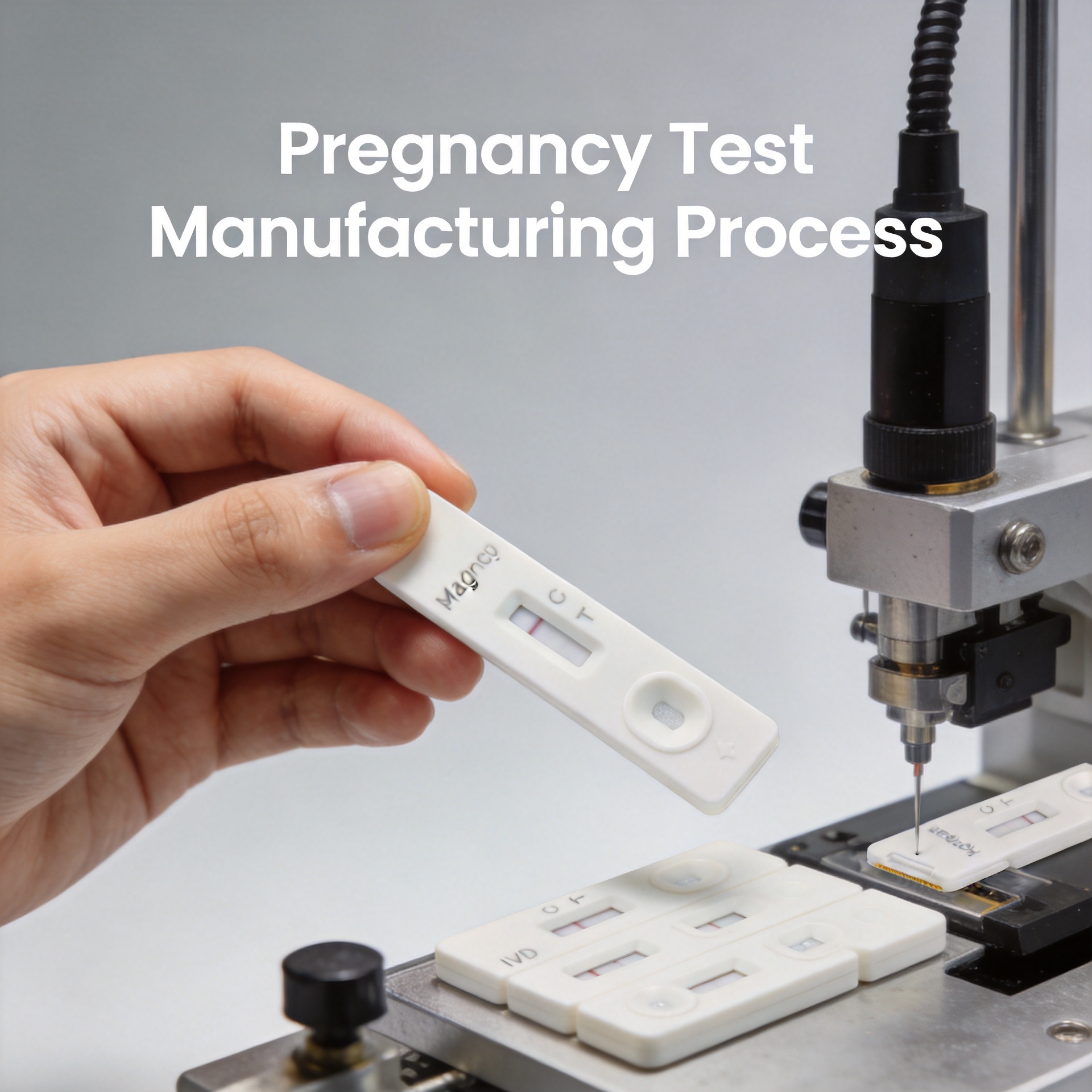
Pregnancy Test Manufacturing Process: From Raw Materials to Final Products
From a product development standpoint, manufacturing a pregnancy test is more technically demanding than its small size suggests. Each pregnancy test strip depends on a precise combination of biological reagents, engineered materials, and validated assembly steps — getting any one of them wrong can compromise the result accuracy that clinical buyers rely on. This overview breaks down the full manufacturing process, from initial raw material selection through to the final packaged diagnostic product.
1. Key Raw Materials in Pregnancy Test Strip Manufacturing
Understanding test strip materials is essential for evaluating pregnancy test quality from a procurement or distribution standpoint. The performance of a pregnancy test is largely determined by the quality of its raw inputs.
The core components include:
- Nitrocellulose (NC) Membrane: The backbone of the lateral flow assay. The NC membrane must have uniform pore size and consistent capillary flow rate — typically expressed in seconds per 4 cm — to ensure the test line and control line develop at the correct speed. Variations in membrane lot quality are one of the most common contributors to batch-to-batch inconsistency.
- Anti-hCG Monoclonal Antibodies: Human chorionic gonadotropin (hCG) is the pregnancy-specific hormone that pregnancy tests detect. Two distinct anti-hCG antibodies are used: one is conjugated to a detection label on the membrane test line, and another is bound to the colloidal gold particles on the conjugate pad.
- Colloidal Gold Nanoparticles: These function as the visual signal generator. Gold particles conjugated with anti-hCG antibodies migrate through the membrane when sample is applied. When hCG is present, the complex is captured at the test line, producing the visible colored band.
- Conjugate Pad: Usually made of glass fiber, this is where the gold-antibody conjugate is loaded and dried. Conjugate pad material and drying conditions directly affect conjugate release behavior during testing.
- Absorbent Pad and Sample Pad: The sample pad regulates flow rate onto the membrane. The absorbent pad draws the sample through the full strip length.
- Backing Card: A rigid plastic or laminate substrate onto which all pads and membrane components are assembled and cut into individual strips.
Not all raw material suppliers produce these components to equivalent specifications. A NC membrane rated at the same nominal pore size from two different suppliers can behave quite differently under identical assay conditions, which is why incoming material qualification is an essential step in any well-managed quality system.
2. The Manufacturing Process: Step by Step
The pregnancy test manufacturing process follows a defined sequence. While specific parameters vary between manufacturers and product formats (strip, cassette, or midstream), the fundamental flow remains consistent.
Step 1: Antibody Conjugation
Anti-hCG antibodies are conjugated to colloidal gold particles under controlled pH and temperature conditions. Under-conjugation reduces signal intensity, while over-conjugation can cause non-specific binding that generates false positives. Conjugation yield and stability are assessed before the conjugate enters production.
Step 2: Membrane Coating (Line Dispensing)
The nitrocellulose membrane is coated with two antibody lines using automated dispensing systems. The test line (T) receives capture anti-hCG antibodies; the control line (C) receives an anti-conjugate antibody confirming proper fluid migration. Line width, concentration, and dispense speed are controlled parameters. Membranes are then dried in a temperature- and humidity-controlled oven.
Step 3: Conjugate Pad Loading and Drying
The gold-antibody conjugate is applied to the glass fiber conjugate pad. Conjugate loading concentration and drying conditions are validated to ensure consistent release during sample testing. Excess humidity during drying can cause conjugate clumping and reduced sensitivity, so this step requires close humidity monitoring.
Step 4: Strip Assembly
The sample pad, conjugate pad, nitrocellulose membrane, and absorbent pad are laminated onto the backing card in sequence with defined overlap distances. Proper overlap ensures uniform fluid flow from sample application through to the absorbent end. This assembly is typically performed by automated lamination equipment to maintain positional precision.
Step 5: Cutting
The assembled laminate is cut into individual strips at a defined width (typically 3–5 mm for standard pregnancy test formats). Blade sharpness and speed affect edge quality — poor cutting can damage the membrane edge and cause irregular sample flow.
Step 6: Cassette or Housing Assembly
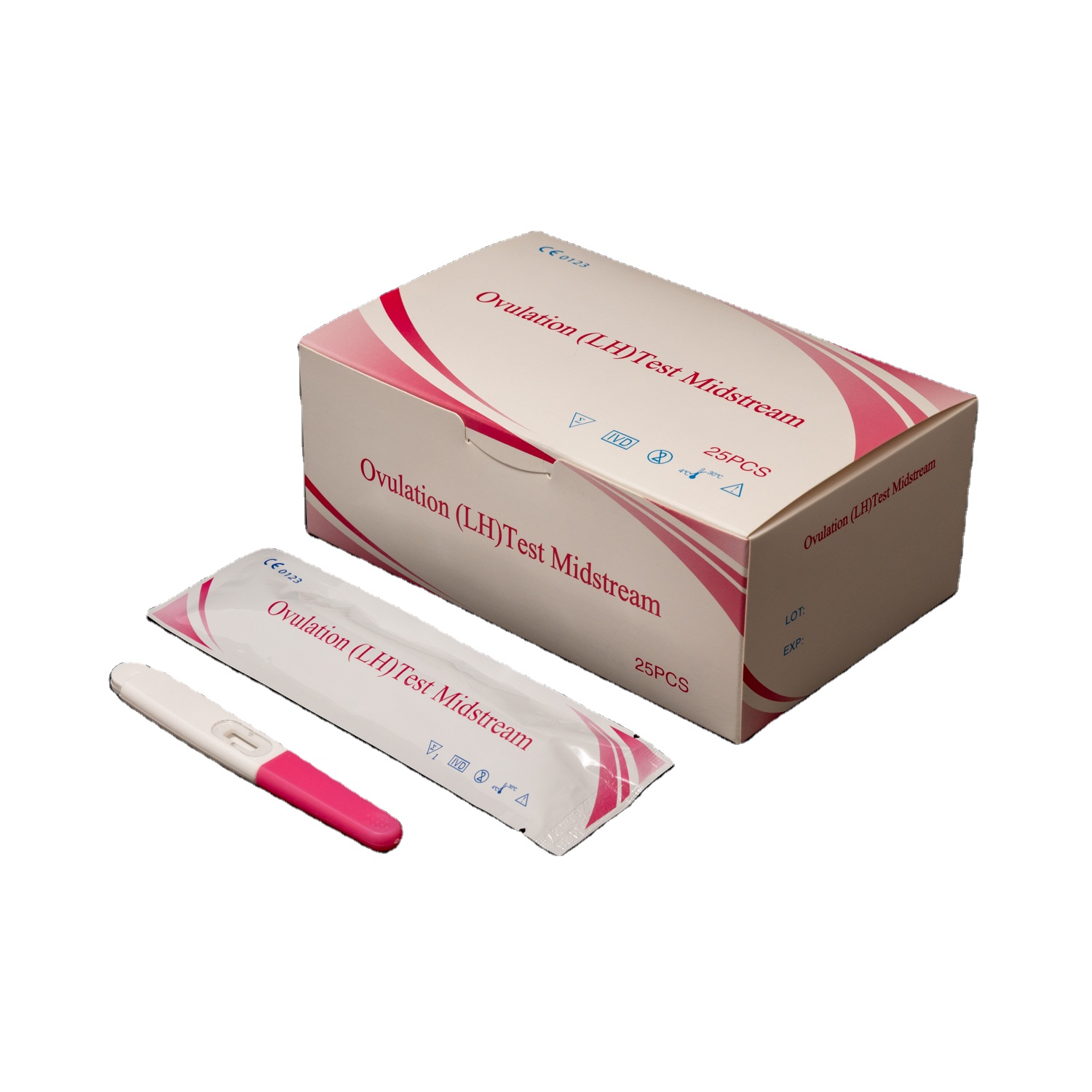
For cassette-format pregnancy tests, the cut strip is loaded into a plastic housing. The sample well and result window must align precisely with the strip's sample pad and membrane regions. Assembly is commonly semi-automated, with operators performing final visual checks.
3. Quality Control in Diagnostic Production
Quality control in pregnancy test manufacturing spans incoming materials, in-process monitoring, and finished product testing. The applicable standard for this type of diagnostic production is ISO 13485, the quality management system framework for medical device manufacturers. Under ISO 13485, manufacturers validate performance characteristics including sensitivity, specificity, and precision, and demonstrate lot-to-lot consistency.
Many procurement teams focus initially on the sensitivity claim — typically expressed in mIU/mL hCG. The real determinants of field performance, however, extend across several dimensions: sensitivity threshold, specificity against cross-reactive substances (LH and FSH), hook effect behavior at high hCG concentrations, and stability of the conjugate and membrane-bound antibodies over shelf life.
Key in-process quality control checks include:
- Membrane flow rate qualification on each incoming lot
- Conjugate OD (optical density) measurement after synthesis
- Line intensity verification after membrane coating using image analysis
- Assembly accuracy checks on pad overlap dimensions
- Finished product panel testing using calibrated hCG standards to confirm sensitivity cutoff
If a storage condition deviation occurs during production — such as conjugate pad drying at higher-than-specified humidity — the affected lot may show reduced sensitivity or increased hook effect susceptibility. Humidity control failures are among the more common causes of batch-level quality issues that emerge during stability testing or post-distribution field reports.
4. Stability Testing and Final Product Validation
Before a pregnancy test is approved for distribution, it must pass stability testing simulating real-world storage and transport conditions. This includes real-time and accelerated aging studies and temperature/humidity stress testing. The objective is to confirm performance within specification throughout labeled shelf life — usually 18–24 months for commercially distributed pregnancy tests.
Final lot testing includes functional performance evaluation using hCG panels and physical inspection of strip appearance, cassette integrity, and packaging seal quality. Lots failing pre-defined release criteria are rejected and investigated.
For manufacturers targeting regulated markets in Europe, CE marking under the IVDR framework requires technical documentation covering performance data, manufacturing process validation, and post-market surveillance commitments.
5. Packaging and Final Product Distribution Readiness
Once lots pass final testing, pregnancy test products are packaged with desiccant pouches to maintain low internal humidity. Packaging seals are validated for integrity under transport stress conditions. Labeling requirements — lot number, expiration date, storage conditions, sensitivity specification, and instructions for use — must comply with each target market's regulatory requirements.
For distributors sourcing pregnancy tests internationally, confirm that the manufacturer's quality system covers post-distribution tracking capability — lot traceability and field quality response are increasingly important for buyers in regulated markets.
Summary
The manufacturing process for a pregnancy test is a tightly controlled sequence of material selection, bioconjugation, membrane processing, assembly, and multi-stage quality control. Each step contributes to the sensitivity, specificity, and batch-to-batch consistency of the final diagnostic product. For distributors and healthcare procurement teams, understanding this manufacturing process provides a more reliable basis for evaluating supplier quality claims than marketing summaries alone.
At JIUHEKIT, we work with manufacturers whose production processes align with ISO 13485 quality standards, and we support our distribution partners with the technical documentation needed for regulatory compliance. Contact us at www.jiuhekit.com to learn more about our pregnancy test sourcing capabilities.